
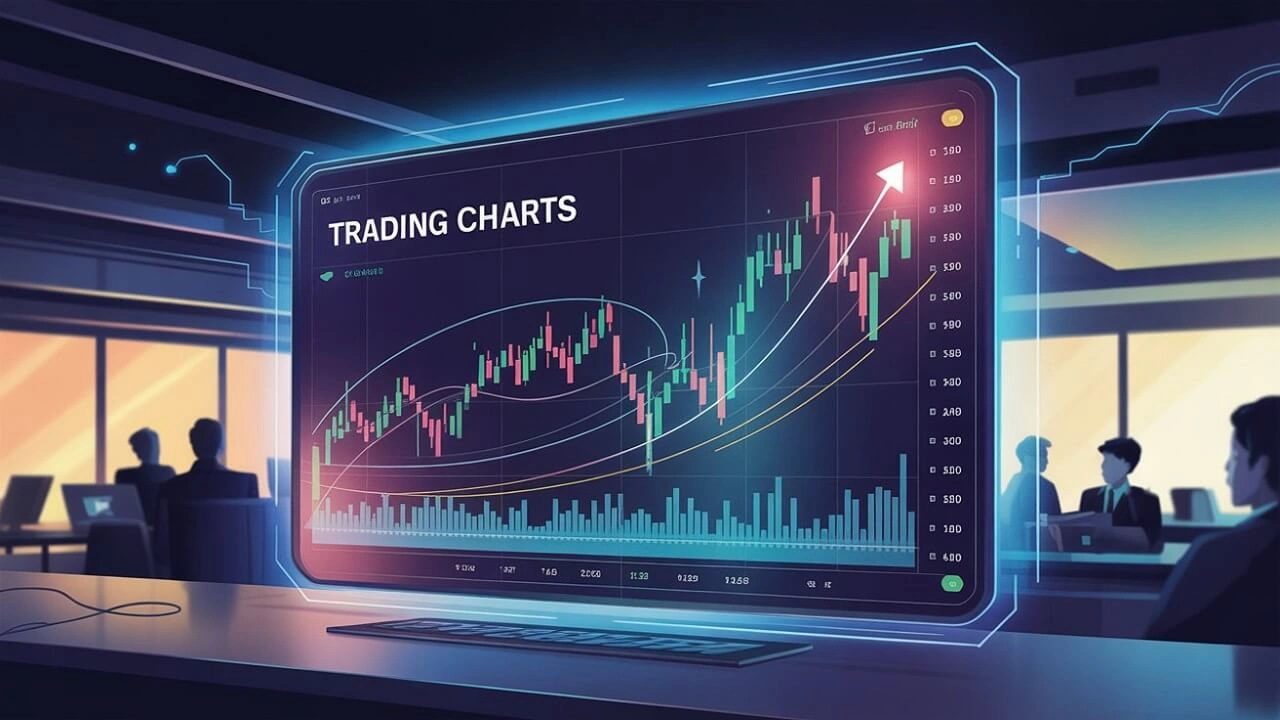
How to Understand and Use Trading Charts
Trading charts are an essential tool for every trader, whether you’re new to the markets or an experienced investor. These visual tools provide real-time insight into price movements, market trends, and trading volumes, helping traders make smarter, more informed decisions.
In this guide, we’ll explore the basics of trading charts, examine their different types, and break down the steps to interpret them effectively—giving you the confidence to analyze the markets like a pro.

Content
What Is a Trading Chart?
A trading chart is a graphical representation of an asset’s price over a specific period. It allows traders to visualize how prices change, making it easier to identify trends, support/resistance levels, and trading opportunities.
Most trading charts plot two key variables:
- Time (horizontal axis)
- Price (vertical axis)
Some advanced charts also show volume and other technical indicators to enhance market analysis.
Key Elements of a Trading Chart
To read a chart effectively, it’s important to understand its core components:
- Open: The price at which the asset started trading during a time period.
- High: The highest price reached.
- Low: The lowest price during the session.
- Close: The final price at the end of the time period.
- Volume: Total units traded, indicating market activity and strength.
These elements form the foundation of technical analysis.
Popular Types of Trading Charts
Understanding different chart types is essential for visualizing data effectively. Here are the most common ones:
1. Line Chart
A line chart connects closing prices over time with a single continuous line.
Advantages:
- Simple and clean visual
- Great for identifying general trends
Limitations:
- Doesn’t show highs/lows or trading volume
2. Bar Chart
A bar chart gives a more detailed view by showing the open, high, low, and close (OHLC) for each time unit.
Advantages:
- More comprehensive than line charts
- Helps spot trend reversals
Limitations:
- May be harder for beginners to read
3. Candlestick Chart
The most popular among traders, candlestick charts use “candles” to show the same OHLC data with color-coding for bullish and bearish movement.
Advantages:
- Visually intuitive
- Shows patterns and momentum
Limitations:
- Requires some practice to interpret correctly
Understanding Market Volume
Volume refers to the number of shares, contracts, or lots traded during a given time. It reflects the strength behind price movements.
- High volume often confirms a trend.
- Low volume may signal consolidation or weak momentum.
Many traders use volume in conjunction with technical indicators like RSI or MACD to validate trade setups.
How to Identify a Trend Using Trading Charts
Spotting trends is one of the main reasons traders use charts. Here’s how:
- Uptrend: Higher highs and higher lows
- Downtrend: Lower highs and lower lows
- Sideways trend: Flat movement within a range
You can also use trendlines and moving averages to visually confirm a trend’s direction.
Advanced Chart Types for Experienced Traders
For seasoned traders, there are more complex charting tools available:
- Heikin Ashi: Smooths price action to make trends clearer
- Renko Charts: Focus on price movement rather than time
- Point and Figure: Filters out smaller price fluctuations
These tools can reduce noise and help filter false signals.
Step-by-Step: How to Read a Trading Chart
Ready to analyze a chart? Follow these steps:
- Choose your chart type (line, bar, candlestick)
- Set your timeframe (1-minute, daily, weekly, etc.)
- Identify key support and resistance levels
- Look for chart patterns (e.g., head & shoulders, triangles)
- Use indicators like moving averages, RSI, or MACD
- Assess volume to confirm market strength
This method gives a structured approach to technical trading.
Using Charts for Technical Analysis
Technical analysis relies heavily on chart patterns and indicators. Traders analyze:
- Price action
- Historical trends
- Support/resistance zones
- Momentum indicators
Charts are the canvas on which all this information is displayed. With practice, they become an intuitive part of a trader’s decision-making process.
Final Thoughts on Trading Charts
Mastering trading charts is a critical skill in your trading journey. Whether you’re identifying trends, setting entry/exit points, or managing risk, charts give you the visual edge to trade smarter. Over time, you’ll learn to trust what the charts tell you—because price never lies.
Understanding trading charts can boost your investment strategy, showing trends, patterns, and market behavior clearly. Learn to interpret them effectively and maximize profits. For partnerships or promotions, feel free to advertise with us and reach a wider audience.
FAQs
What is the best type of trading chart for beginners?
A candlestick chart is popular because it’s easy to read and shows rich price information, including open, high, low, and close.
Can trading charts predict future price movement?
While no chart can predict the future with certainty, they help traders identify high-probability trade setups based on historical price behavior.
Clifford Rosen is a wonderful person. He is very nice and always willing to help out! He loves his job because it lets him share interesting things with people who want to know about new developments in the world of technology.

